
Nivogenesis
How does a snow crystal become a branching star? Only Chapter 1 of this bilingual visual story is officially published, with new episodes coming soon.
The Curiosity
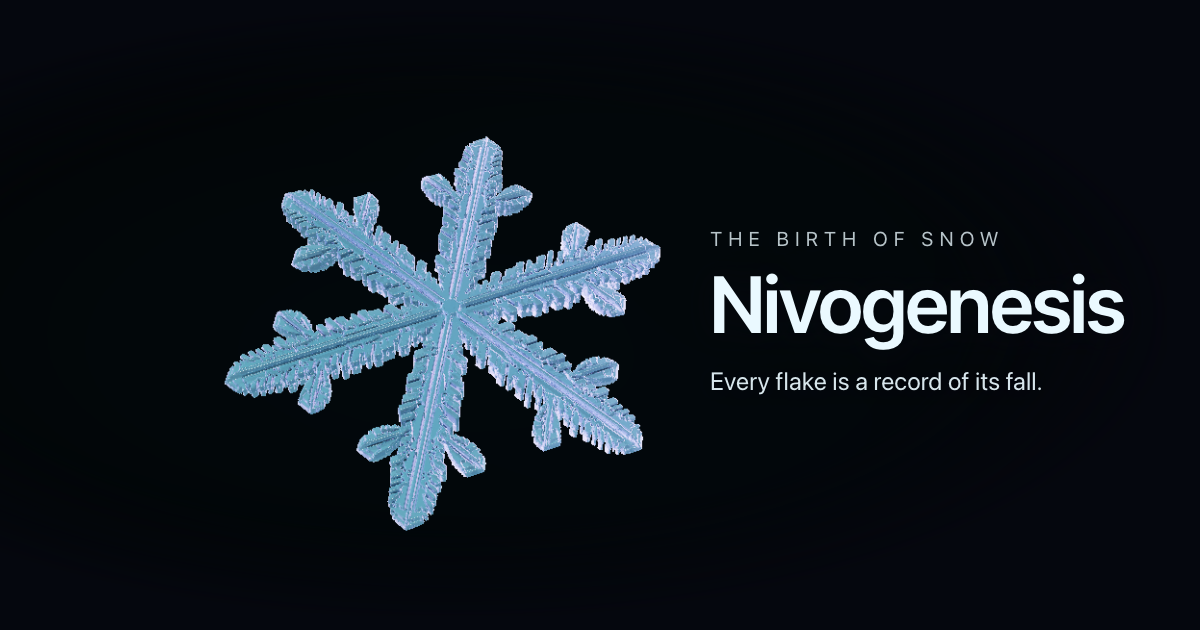
Look at a snow crystal's arms. They grow in different places, yet their branching patterns can look remarkably alike. How does that happen?
Nivogenesis starts with that visible puzzle and follows one crystal back to its beginning. The aim is to make the growth of snow something you can see and understand, using ordinary language written for an eight-year-old's starting knowledge.
The Build
The website opens with a growing crystal, then carries it into snowfall. Chapter 1 follows a small beginning in a cloud, water crossing the air to join the ice, the repeating structure behind six directions, corners becoming arms, a shared journey through changing surroundings, and a final look at other crystal shapes.
Rendered crystals show the shapes; animated diagrams make the hidden processes visible. The explanation builds one step at a time, with the visual stage beside the text on desktop and above it on a phone. The first piece of ice stays in view as new ice grows around it.
- Published
- Chapter 1 only; new episodes coming soon
- Languages
- English and Mandarin, with optional narration in both
- Presentation
- Read at your own pace or watch in movie mode
- Motion
- Still and reduced-motion options
Narration follows the words and animation. Scroll to pause and inspect an idea, then resume from the paragraph in view. Switching language keeps the same idea in place. Movie mode gives the story a larger stage with subtitles and playback controls.
The Result
Only Chapter 1 is officially published, available in English and Mandarin. It follows a crystal from its beginning to a branching star, then introduces plates, hollow columns and columns with plates at their ends.
The central takeaway is simple: a crystal's shape comes from how water fits together, where new ice grows, and the surroundings along the way. Nearby arms share nearly the same changing conditions, so their broad patterns can resemble one another while their fine details differ.
What I Learned
The words and pictures have to explain the same event. A rotating crystal can reveal its thickness, but showing water reaching the ice, leaving again, or staying needs a different kind of picture. Each change of scale or representation has to earn its place in the story.
The opening crystal is also the ending's test: after following its growth, the viewer should have a reason for the shapes they can see.
A single-line diagram editor for datacenter power. Draw the system and the power flow is simulated as you go.
A hobby library. What the top of each hobby looks like, then the first step. One complete guide a day, the same for everyone.
A VR garden for kinetic sculpture. Place a few blocks with your hands, and they repeat into a spinning ring you can walk around, then print.