
Pixel Match
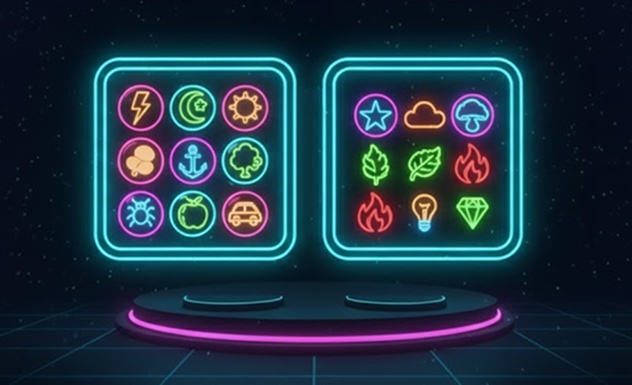
Spot the one icon two cards share, faster than your friends. The decks are drawn by a model from whatever you type.
The Curiosity
This one started as a question someone asked in the community forum. Codoo had already shown that a language model could generate a board game's words forever. Could the same thing be done for pictures?
The game underneath is the old matching card game: any two cards share exactly one symbol. That is not luck, it is a finite projective plane you can hold in your hand. Fifty-seven symbols, fifty-seven cards, eight per card, and the maths guarantees the match. What never changes is the artwork. The symbols printed on the cards are the symbols you get, forever.
So leave the geometry alone and hand the pictures over. Everyone builds a deck out of whatever they think to type, which quietly turns a deck into a piece of self-expression. Then the part that is actually interesting: every new player you sit down with brings a deck you have never seen, and you meet the person a little through the images they asked for.
The Build
The card layout is the projective plane of order 7, computed once and stored as a template of symbol indices. Each game maps those indices onto a random set of icons, so the structure is fixed and the deck is never the same twice.
Icons come from a deck library. Type a prompt and an image model draws a set; keep the ones you like; share the deck or keep it private. Games run for one to four players over Firestore with a lobby, ready-up, rematch and QR-code invites.
A round can only be won once. That sounds obvious and took a bug to learn.
- Geometry
- Projective plane of order 7: 57 cards, 8 symbols each, one shared symbol per pair
- Icons
- Generated from text prompts into personal and public decks
- Players
- 1 to 4, real time, on phones
The Result
Fast rounds, silly decks, playable across a table.
What I Learned
Real-time games are mostly about deciding who is allowed to be right first. Everything else is presentation.